
BPEXCH Rummy TDS Policy

Understanding tax rules is an important part of responsible online gaming. For players using BPEXCH Rummy, knowing how Tax Deducted at Source (TDS) may apply to rummy winnings can help avoid confusion when checking balances, withdrawals, and transaction records.
The BPEXCH Rummy TDS Policy is designed to explain how applicable taxes may be handled when players receive taxable winnings. The purpose of this policy is to provide greater transparency while helping users understand the relationship between their rummy winnings, withdrawals, and applicable tax obligations.
What Is TDS?
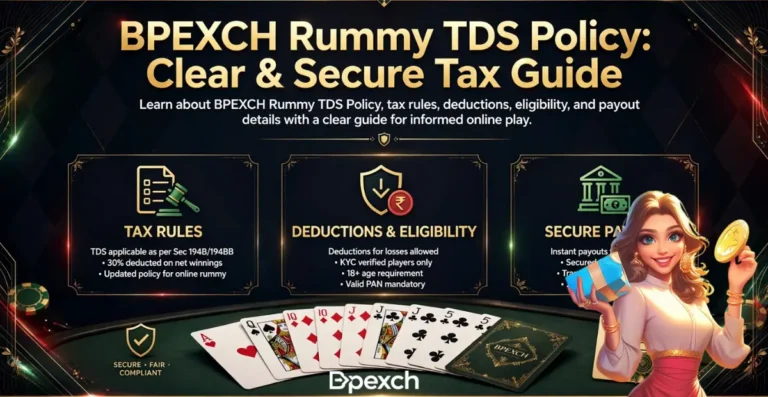
TDS stands for Tax Deducted at Source. It is a mechanism through which tax is collected at the time certain types of income are paid or credited rather than being collected entirely at a later stage.
For online gaming users, TDS may become relevant when taxable winnings meet the threshold or conditions established by applicable tax regulations. Instead of requiring the player to calculate and pay the entire applicable amount independently, the platform may deduct the required tax before releasing the relevant amount.
This system is intended to make tax collection more organized and transparent.
How TDS Applies to Rummy Winnings
Under applicable Indian tax rules, online gaming winnings can be subject to taxation. The tax treatment may apply to net winnings, depending on the rules in force.
For example, if a player deposits money, participates in rummy games, and generates winnings, the taxable amount may be calculated according to the applicable legal framework rather than simply treating every deposit or transaction as taxable income.
BPEXCH may therefore apply TDS when legally required. Any deduction should be reflected in the player’s transaction or withdrawal records where appropriate.
Because tax rules are subject to change, players should not rely on historical rates or thresholds without checking the current regulations.
Understanding Net Winnings
One of the most important concepts in an online rummy TDS policy is the difference between total money handled through an account and net winnings.
A player’s account may include:
- Deposited funds
- Promotional or bonus amounts
- Game entries
- Returned stakes
- Winnings
- Withdrawable balances
- Previous losses or adjustments
TDS treatment may depend on the applicable definition and calculation of net winnings under current law.
For this reason, players should carefully review their account statement rather than assuming that every amount credited to their account represents taxable winnings.
When Can TDS Be Deducted?
TDS may be deducted when the conditions prescribed by applicable tax law are met. The timing and calculation can depend on the relevant statutory requirements.
BPEXCH may monitor eligible gaming transactions and apply the required deduction when a taxable event occurs. Where a deduction is made, the corresponding amount may be shown in the user’s transaction history, account statement, or withdrawal information.
Players should understand that the platform’s deduction of TDS does not necessarily replace every tax responsibility they may have. Depending on their circumstances, additional reporting or compliance obligations could apply.
TDS and Withdrawals
Players often assume that tax is deducted only when they request a withdrawal. However, the applicable tax framework may determine when TDS is required.
Therefore, the amount available for withdrawal may differ from the gross amount shown before a required deduction.
For example, a player may see a particular amount associated with eligible winnings, while the final amount transferred after applicable deductions could be lower. The difference may represent TDS or another permitted adjustment.
Maintaining Transaction Records
Keeping accurate records is an important part of managing online gaming income.
Players should consider retaining:
- Deposit confirmations
- Withdrawal records
- Game transaction histories
- Winning and losing statements
- TDS-related information
- Account statements
- Relevant tax documents
These records can make it easier to understand account activity and support accurate tax reporting if required.
Players should also avoid relying solely on screenshots or informal messages. Official account statements and applicable tax documents are generally more useful for financial recordkeeping.
Tax Documentation
Where required by law, information relating to TDS may be reported through the appropriate tax reporting system. Players may receive or access documentation containing information relevant to their deducted tax.
Users should check that important details such as their name, identification information, and transaction records are accurate. If there appears to be an inconsistency, the player should contact the appropriate BPEXCH support channel or consult a qualified tax professional.
What Players Should Know About Tax Rates
Tax rates and rules can change through legislation, regulations, government notifications, or other official guidance. Consequently, users should avoid assuming that a rate discussed online or used previously will remain applicable indefinitely.
The BPEXCH Rummy TDS Policy should be interpreted together with the tax laws applicable at the relevant time.
If a player has substantial gaming income or a complicated transaction history, professional tax advice may be appropriate. A qualified tax adviser can explain how current rules apply to an individual’s specific circumstances.
Transparency and Responsible Account Management
A transparent TDS process can help players understand why the amount credited or withdrawn may not always match the gross winnings displayed during gameplay.
BPEXCH can support transparency by maintaining clear transaction records and showing applicable deductions where required.
Players can also contribute to responsible account management by regularly checking their statements, monitoring withdrawals, and keeping their personal and financial information accurate.
Understanding tax deductions is not only about compliance—it also helps users make better financial decisions.
What Happens If a Player Disagrees With a Deduction?
If a player believes that a TDS deduction has been calculated incorrectly, the first step should be reviewing the relevant transaction history and account statement.
The player can then contact customer support with appropriate transaction details. Useful information may include the transaction date, amount, reference number, and a description of the concern.
BPEXCH may review the account records and provide clarification according to its procedures.
Player Responsibilities
Although BPEXCH may deduct TDS when required, players remain responsible for understanding their own tax obligations.
Users should:
- Review applicable tax laws.
- Keep complete transaction records.
- Check TDS-related information carefully.
- Report income where required.
- Retain relevant tax documentation.
- Seek professional advice when necessary.
Following these steps can reduce confusion and make financial recordkeeping easier.
Privacy and Security of Tax Information
Tax-related information can contain sensitive financial details. Players should therefore protect account credentials and avoid sharing passwords, OTPs, payment information, or tax documents with unauthorized individuals.
BPEXCH should handle user information according to its applicable privacy and security policies. Players should use official support channels when discussing account or tax-related matters.
Never provide confidential account information to an unknown person claiming to represent the platform.
Frequently Asked Questions
Is rummy income taxable?
Online gaming winnings may be taxable under applicable law. The exact treatment depends on the current tax rules and the player’s circumstances.
Does BPEXCH deduct TDS from every transaction?
Not necessarily. TDS is generally connected to the conditions established by applicable tax regulations. Players should check their transaction statements and the current policy.
Is TDS the same as the entire tax liability?
No. TDS is a method of collecting tax at source. A player’s overall tax obligations may involve additional requirements depending on applicable law.
Where can I check my deductions?
Players should review their BPEXCH account transaction history, withdrawal records, and any available tax-related documentation.
Conclusion
The BPEXCH Rummy TDS Policy provides a framework for understanding how applicable tax deductions may affect online rummy winnings. By understanding concepts such as TDS, net winnings, withdrawals, documentation, and player responsibilities, users can manage their gaming accounts with greater confidence and transparency.
The most important principle is to keep accurate records and stay informed about current tax requirements. BPEXCH may apply deductions when required by law, but individual players should also understand and fulfill any tax obligations that apply to them.